
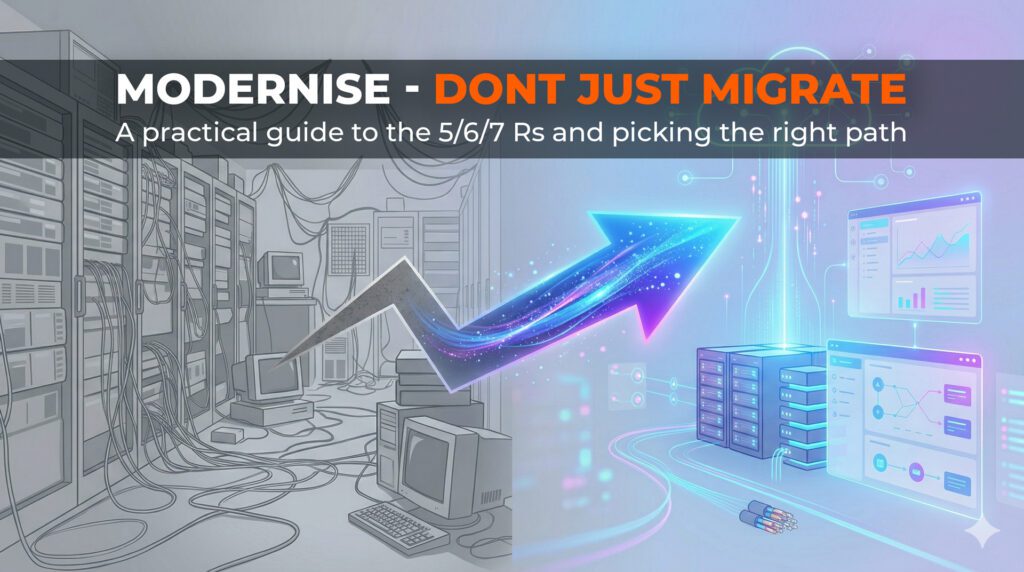
If you are planning technology investment this year and your stack includes ageing systems, this guide is for you. It sets out sensible, low-risk ways to modernise without derailing business as usual and shows where a simple move to the cloud helps, and where it only kicks the problem down the road.
SME leaders want predictable outcomes, controlled costs and measurable benefits. The good news is that application modernisation can be staged, evidenced and governed so you see value early, reduce risk and only scale what works.
This article defines modernisation in plain language, explains the 5, 6 and 7 Rs, gives selection criteria and trade-offs for each, and closes with a readiness checklist plus a realistic 3 to 6 month SME timeline.
What application modernisation means in simple words
Application modernisation means improving an existing system, so it stays useful, secure and cost-effective as your business and technology change. In practice, this can range from minor tweaks that improve usability to deep changes that reshape architecture for scale and agility. The aim is to reduce risk and cost while increasing speed of change, visibility and user satisfaction.
Lift and shift vs true modernisation
Lift and shift (rehosting) moves workloads to new infrastructure with minimal changes. It is fast and can cut hosting costs, but it rarely fixes performance bottlenecks, licensing pain, poor workflows or weak integration.
True modernisation improves how the system is built and used. That might mean replatforming to managed services, refactoring problem areas into clean modules, exposing APIs for integration or rearchitecting toward microservices or event-driven patterns where justified. The approach should be value-led, not tech-led.
The 5, 6 and 7 Rs explained
You will see different counts because lists expand the same ideas. Here is a unified view with clear triggers and trade-offs.
- Retire (remove)
- When to choose: no business value, duplicated capability, or compliance risk from stale data.
- Benefits: immediate cost and risk reduction.
- Trade-offs: data archival and change management still required.
- Retain (revisit later)
- When to choose: stable, compliant system with low change pressure; dependent projects must land first.
- Benefits: avoids unnecessary spend.
- Trade-offs: technical debt may grow; plan a review date.
- Rehost (lift and shift)
- When to choose: quick exit from on-prem hosting, contract pressure or capacity constraints.
- Benefits: speed, potential cost relief, minimal change risk.
- Trade-offs: does not fix code or data issues; optimisation comes later.
- Replatform (move to a new runtime or managed service)
- When to choose: want managed databases, containers or serverless to cut ops overhead.
- Benefits: improved reliability, scaling and patching.
- Trade-offs: some code and config changes; provider constraints apply.
- Refactor (improve code without changing core architecture)
- When to choose: code quality or performance blocks new features; tests can be added.
- Benefits: faster releases, fewer defects, targeted performance gains.
- Trade-offs: needs engineering time and discipline; scope creep must be controlled.
- Rearchitect (change system design)
- When to choose: scaling, resilience, data model or integration limits cannot be solved incrementally.
- Benefits: unlocks growth, resilience and team autonomy.
- Trade-offs: highest change risk and cost; must be staged with clear milestones.
- Replace (buy or rebuild)
- When to choose: product is end-of-life, customisation is brittle, or TCO is higher than alternatives.
- Benefits: resets capability, removes legacy constraints.
- Trade-offs: migration complexity, training and vendor lock-in considerations.
Answers in short:
- The 7 Rs of application migration: retire, retain, rehost, replatform, refactor, rearchitect, replace.
- The 6 Rs of migration: usually the same list without either retain or replace, depending on source.
- The 5 Rs of modernisation: common sets include rehost, replatform, refactor, rearchitect, replace.
How to pick the right R
Use objective criteria so decisions are repeatable and defensible.
- Business drivers: revenue impact, regulatory deadlines, customer experience, cost to serve.
- Technical signals: performance incidents, security posture, test coverage, deployment frequency.
- Data complexity: volume, quality, lineage, PII/PHI sensitivity, cross-system dependencies.
- Integration surface: number and criticality of inbound/outbound interfaces and APIs.
- Total cost of ownership: licences, infrastructure, support, vendor fees, people time.
- Change risk: operational windows, busy seasons, training needs, stakeholder readiness.
Typically, the biggest driver of application modernisation is business agility, often expressed as speed to deliver new features safely. Cost, security and compliance are close behind.
Staged delivery that reduces risk
Modernisation succeeds when broken into predictable stages.
DISCOVERY
- Outcomes: business goals, system inventory, quick-win map, ROI hypotheses.
- Deliverables: current-state diagram, pain-point ledger, value cases.
ASSESSMENT
- Outcomes: option appraisal across the Rs, budget drivers, risks and mitigations.
- Deliverables: architecture options, effort bands, timeline, governance plan.
PILOT
- Outcomes: prove value in a narrow slice such as one workflow or integration..
- Deliverables: working prototype, test results, user feedback, KPI baseline vs delta.
SCALE
- Outcomes: phased rollout with monitoring, training and benefits tracking.
- Deliverables: release plan, runbooks, metrics dashboards and agreed cadence for improvements.
This four-stage model answers the question on stages of modernisation and mirrors how Atula runs engagements, with rapid prototyping and managed rollouts.
Budget drivers to make explicit
Budget and timeline vary by:
- Licensing changes and exits, including per-seat and database licences
- Environment choices (dedicated VPC, managed services, container platforms)
- Data complexity and quality work, including cleansing and migration
- Integrations and API effort across CRMs, ERPs, marketplaces and carriers
- Security and compliance uplift, from encryption to access control and audits
- Change management, training and support during transition
For SMEs, clarity here helps avoid surprises and supports a sequenced plan that funds itself through early wins.
Quick wins that do not disrupt BAU
- Wrap legacy with APIs to remove rekeying, sync stock or expose job status. If you are exploring this, see our approach to APIs and integration to understand how design-first and testing reduce risk.
- Targeted containerisation of a single service to stabilise deployments and create a path to further improvements.
- UX refresh for high-friction screens to cut clicks and errors, supported by analytics.
- Automate reports and alerts to surface real-time visibility for managers.
If your plan includes a new web interface or mobile workflows, our web application development services and mobile application development solutions illustrate delivery patterns that minimise risk while improving usability.
How Atula reduces delivery risk
Atula Technologies delivers low-risk modernisation through:
- Structured discovery focused on measurable outcomes and ROI
- Rapid prototyping to validate assumptions with real users
- Staged rollouts with CI/CD, staging validation and managed change windows
- Governance with stakeholder alignment, acceptance criteria and benefits tracking
- Post-launch monitoring plus support and maintenance services to keep value compounding
For bespoke systems that need targeted rebuilds or extensions, we provide custom software development services that retain your IP and avoid lock-in.
Expected ROI and measuring success
Modernisation typically returns value through reduced licences and hosting waste, lower incident volumes, faster change, and better customer or staff experience. Define KPIs up front, for example:
- Cycle time from idea to release
- Defect rate in production
- Mean time to recovery for incidents
- Order-to-dispatch time or first-time fix rate
- User task time on key journeys
Track the before and after during pilot and scale stages.
A realistic 3 to 6 month SME example
- Weeks 1 to 3, Discovery and assessment
- Map systems and integrations; confirm objectives; score Rs options by value and risk; define pilot scope; baseline KPIs and budget drivers.
- Weeks 4 to 8, Pilot
- Weeks 9 to 12, Scale phase 1
- Harden architecture; containerise the new module; extend API coverage; roll out to one business unit; refine runbooks and training; track KPIs weekly.
- Weeks 13 to 20, Scale phase 2
- Address two more workflows; retire one obsolete component; consolidate dashboards for real-time visibility; present benefits realisation and agree next Rs decisions.
Success metrics could include 30 to 50 percent reduction in manual rekeying, 20 percent faster order-to-dispatch, and release cadence improving from quarterly to monthly. Actual results vary by context, but the pattern holds.
FAQ
- What is application modernisation?
- Improving an existing system so it remains secure, efficient and easy to change, often by updating architecture, integrations and user experience.
- What are the 7 Rs of application migration?
- Retire, retain, rehost, replatform, refactor, rearchitect, replace.
- What are the 6 Rs of migration?
- A shortened list of the above, usually omitting either retain or replace depending on the source.
- What are the 5 Rs of modernisation?
- Commonly rehost, replatform, refactor, rearchitect, replace.
- What is the biggest driver of application modernisation?
- Business agility, expressed as the need to deliver change faster and safer, followed closely by cost and compliance.
- What are the 4 stages of modernisation?
- Discovery, assessment, pilot, scale.
- What are the 4 pillars of digital transformation?
- People, process, technology and data, aligned to deliver measurable outcomes.
- What is lift and shift vs modernisation?
- Lift and shift moves workloads as-is, usually to the cloud. Modernisation improves design, code, integrations and operations to deliver better outcomes.
Readiness checklist
- Objectives and KPIs agreed with stakeholders
- System and integration inventory complete, with ownership mapped
- Data risks understood, including quality, privacy and retention
- Rs options scored with triggers, trade-offs and recommended path
- Pilot slice defined with clear success criteria and rollback plan
- Budget drivers and constraints documented
- Governance, release plan and change management agreed
- Support model and monitoring in place before scale
Next step
If this resonates and you want a pragmatic, low-risk plan, book a no-obligation chat with our Tech Lead to review your options and shape a modernisation roadmap:
Final note: modernise to unlock value and migrate only when movement alone delivers a clear benefit. The right mix of Rs, proven in a pilot, is the safest route to predictable outcomes.